Lecturer Felicity Harding took us through the life and works of Sir David Wilkie, a Scottish painter born in Pitlessie, Fife, in 1785. From an early age, he showed a strong interest and talent in art. Although his father was reluctant to support his ambitions, Wilkie attended the Trustees Academy in Edinburgh, where he spent five years developing his artistic skills. During this time, he became particularly skilled at observing and portraying people, expressions, everyday activities and small details.
One of Wilkie’s best-known early paintings was Pitlessie Fair, (1804) presenting a lively and humorous view of village life. It includes 104 people, as well as dogs, demonstrating Wilkie’s ability to capture many characters within one busy scene. His interest in ordinary country people continued in works such as Village Politicians (1806), which was exhibited at the Royal Academy in London after he moved there in 1805.
Wilkie developed his “genre” with The Blind Fiddler (1807), which received considerable critical and public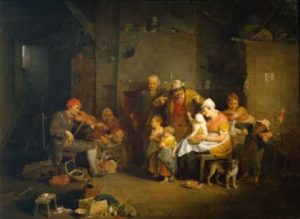 praise. He followed this with The Card Players and Rent Day (1808) again showing ordinary people involved in familiar activities. His growing reputation led to his election as a full Academician to the Royal Academy in 1811.
Wilkie worked hard at his art, using family members as models and creating miniature sets in boxes in order to study how light affected faces, furniture and surroundings. He gained increasing acclaim selling his action packed “Blind Man’s Buff” (1813) to the Prince Regent for 500 guineas.
However, Wilkie’s style changed after travelling through France, Italy and Spain between 1825 and 1828. He began painting more historical subjects, moving away from the everyday country scenes that had made him so famous. This change was criticised. So to this day, it is his early genre paintings that are most appreciated and remain an important record of rural and everyday life.
Liz Beecheno