
Harry Venning gave us an energetic, entertaining and amusing lecture on his life as a cartoonist, along with a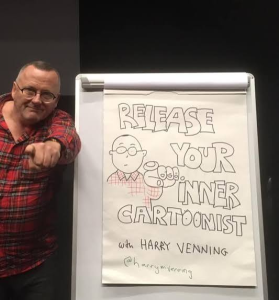 light-hearted glimpse into the development of cartooning through history.
Harry first started drawing cartoons for free newspapers in the 1980s and 1990s, before going on to work for The Guardian for 25 years with his popular strip cartoon Claire in the Community, which subsequently became a Radio 4 sitcom. He also created Hamlet, the actor pig, for The Stage magazine.
The word “cartoon” comes from the Italian cartone, meaning a large or thick piece of paper or card. One of the earliest cartoonists to achieve fame was John Leech, who satirised the 1843 Exhibition of Art in Westminster Hall with his cartoon Substance and Shadow for Punch magazine. Leech went on to become a well-known cartoonist, and cartoons developed into a popular medium for humorous and satirical drawings.
It was James Gillray who is regarded as one of the founding fathers of British political and satirical cartooning. His famous 1805 cartoon The Plumb-pudding in Danger depicted William Pitt and Napoleon carving up the “plum pudding” of the world – this has become one of the most enduring examples of political cartooning.
During the second half of the 19th century, cartooning expanded rapidly, particularly in America, where cartoons became one of the most popular features of newspapers. For immigrants, they were also a great way of learning English while enjoying a good laugh at the same time.
Harry also introduced us to Mort Walker’s The Lexicon of Comicana, a light hearted look at the devices and symbols used by cartoonists. Walker invented an international set of symbols after studying cartoons from around the world. Harry illustrated these symbols by rapidly drawing cartoons on his flip chart to great effect, demonstrating how the meaning or humour of a cartoon can be completely changed by adding just a line or a simple symbol.
Harry went on to mention many other great cartoonists and characters, including Charles Schulz’s Peanuts, as well as Hergé’s Tintin. His lecture was extremely well received and generated plenty of laughter, as well as sparking a lively question-and-answer session afterwards.
Liz Beecheno